by German Lopez
05.24.2013
2 hours ago
Medical marijuana advances, commissioners threaten streetcar, voter fraud report released
If you have any questions about Cincinnati, CityBeat’s staff will do its very best to answer if you submit them here.
The Ohio Ballot Board certified an amendment
that would legalize medical marijuana and industrial hemp in Ohio.
Petitioners will now have to gather 385,253 signatures to get the issue
on the ballot — most likely this year or 2014. CityBeat previously covered Ohio’s medical marijuana movement in greater detail here.
Republican county commissioners are asking the Ohio, Kentucky and Indiana Regional Council of Governments to pull $4 million in streetcar funding,
but the city says OKI can’t legally do it. Commissioners Greg Hartmann
and Chris Monzel, who are also members of the OKI board, made the
request in a letter. City spokesperson Meg Olberding says OKI was simply
an agency that passed the money along as it worked through the Federal
Transit Administration (FTA) to OKI to the Southwest Ohio Regional
Transportation Authority (SORTA), and the agreement doesn’t allow OKI to
interfere any further. This morning, the city’s Twitter account
tweeted, “City has confirmed with Feds that OKI cannot pull streetcar $
bc funds are already obligated to this federal project.”
Ohio released its first ever statewide report on voter fraud yesterday, called the “Post-2012 General Election Voter Fraud Report.”
Secretary of State Jon Husted said the report shows voter fraud exists,
but it’s “not an epidemic.” That coincides with previous findings from
researchers: An extensive study of the nation’s databases by News21, a
Carnegie-Knight journalism initiative, found no evidence of widespread voter fraud.
Ohio Democrats are proposing more accountability rules
for JobsOhio, including adherence to public record laws, open meeting
laws, state ethics laws for employees and full state audits. JobsOhio is
a privatized nonprofit agency established by Gov. John Kasich and
Republican legislators to eventually replace the Ohio Department of
Development. They claim the privatized nature of the agency allows it to
respond to economic problems more quickly, but Democrats say the agency
redirects public funds with minimal oversight.
Cincinnati will host a march against genetically modified organisms
Saturday as part of the international March Against Monsanto. The
movement’s organizers are calling on participants that explain the facts
of genetically modified organisms, encouraging “no slandering, no
opinions or paper — just facts.” The protest is scheduled for 1 p.m. at
Piatt Park.
A.G. Lafley is reclaiming the top spot at Cincinnati-based Procter & Gamble. The company says the change is not part of a deeper issue.
The 35th annual Taste of Cincinnati begins tomorrow.
Win or lose, the University of Cincinnati baseball team has a lot of fun.
An adorable Labrador Retriever puppy had her heart cured after a minimally invasive heart procedure — the first ever in the Tri-State.
Salamanders have some lessons for humans when it comes to regrowing limbs.
1 Comment · Wednesday, May 8, 2013
If you can’t beat them, make it so they
can’t play to begin with. That’s been the mentality of the Ohio
Republican Party time and time again, and the latest budget bill from
the Republican-controlled Ohio House continues the trend.
0 Comments · Wednesday, May 8, 2013
An amendment in the budget bill approved by the Republican-controlled Ohio House could make voting more difficult for out-of-state college and university students.
by German Lopez
05.07.2013
17 days ago
Posted In:
News,
Energy,
Voting,
Budget at 09:14 AM |
Permalink |
Comments (0)
Measure may limit voting, city tops LEED certified buildings, Medicaid could be on ballot
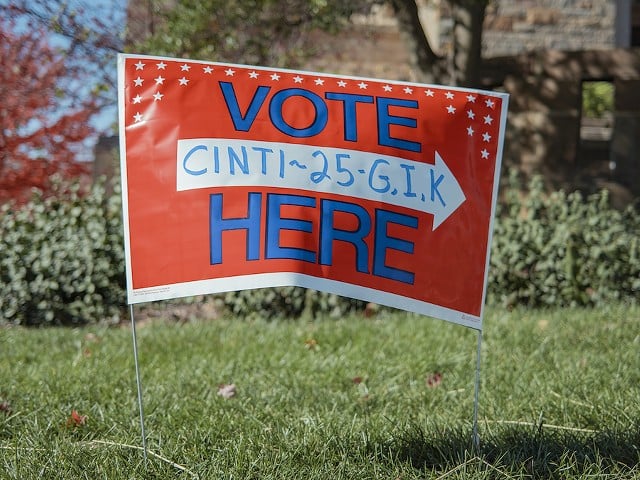
Today is primary election day in Ohio, but there are no
ballot items in Cincinnati. Some Hamilton County precincts outside the
city have ballot issues, which are listed here. Polls will be open between 6:30 a.m. and 7:30 p.m.
An amendment snuck into the budget bill approved by the Republican-controlled Ohio House would force universities to decide
between providing the proper documentation for voting to out-of-state
students or getting extra money from out-of-state tuition rates,
prompting concerns from Democrats that Republicans are attempting to
limit voting opportunities once again. Republicans spent a bulk of the
lead-up to the 2012 election approving measures that limit voting,
including a later-repealed set of laws that greatly reduced early voting
hours.
About 82 percent of all Leadership in Energy and
Environmental Design (LEED) certified buildings in Ohio are in
Cincinnati, and the reason is likely local tax incentives,
which allow Cincinnatians to eliminate property taxes for up to
15 years by retrofitting businesses and homes in an environmentally
friendly manner. CityBeat covered Cincinnati’s successes in solar energy here and FirstEnergy’s campaign to weaken Ohio’s energy efficiency standards here.
If legislators fail to take up the Medicaid expansion, the issue could appear on the ballot
on November 2014. Supporters of the expansion, including Gov. John
Kasich, say the expansion will help insure hundreds of thousands of
Ohioans and save the state money in the next decade, but Republican
legislators say they’re concerned the federal funds backing the
expansion will eventually dry up. CityBeat covered the Ohio House budget bill, which effectively rejected the expansion for the time being, here.
The Ohio Department of Transportation says 2,230 bridges in the state need repairs, but there’s not enough funding to make it happen.
Ohio banks are warning of possible cyberattacks
that could happen today. The Ohio Bankers League and the Ohio Credit
Union League said the attacks would impact online services but not the
security of customers’ bank accounts.
The Cincinnati/Northern Kentucky International Airport has the second highest airfares in the nation, according to statistics released by the U.S. Department of Transportation’s Bureau of Transportation Statistics.
Cincinnati-based Procter & Gamble was ranked No. 7 in a ranking for top 50 most diverse companies by DiverseInc.
Sometimes human brains make people do bad things, such as enjoying high-calorie foods even when the foods aren’t delicious.
by German Lopez
05.06.2013
17 days ago
Posted In:
News,
Voting at 02:14 PM |
Permalink |
Comments (1)
Budget bill forces universities to decide between out-of-state tuition, providing documents
An amendment snuck into the budget bill passed by the
Republican-controlled Ohio House on April 18 would force public
universities to decide between charging lucrative out-of-state tuition
rates or providing out-of-state students with documents required for
voting in Ohio, raising concerns from Democrats that Republicans are
attempting to limit voting opportunities in the state once again.
The measure would force public universities to classify
students living on campus as in-state if they receive utility bills or
official letters that can be used for identification when voting in
Ohio.
Out-of-state tuition rates are typically higher than
in-state tuition rates, which means universities would be giving up
potentially millions in revenue to provide out-of-state students with
the proper documents.
For universities, the measure adds a financial incentive
to hold on to the documents. For out-of-state students, that could mean a
more difficult time getting the documents to vote in Ohio
elections.
Students can vote in Ohio if they have lived in the state
for at least 30 days, but voting requires proper identification and proof of residency. Utility
bills and official letters qualify, but student identification cards do
not.
Republicans have been quick to defend the measure, while
Democrats have been quick to oppose it. For both sides, there’s a clear
political motivation: In the 2012 elections, 63 percent of Ohio voters
aged 18 to 29 supported Democratic President Barack Obama, while only 35
percent supported Republican Mitt Romney, according to exit poll data.
Ohio House Speaker William Batchelder justified the measure to the Toledo Blade:
“The real issue for local areas in particular [is], what happens when
somebody from New York City registers to vote. How do they vote on a
school levy? How do they vote on a sheriff’s race? To me, there is a
significant question, particularly the levies, as to what having people
who don’t have to pay for them would do in terms of voting on those
things.”
The comments prompted a response from Ohio Democrats,
particularly attorney general candidate David Pepper, a Greater
Cincinnati native.
“It’s startling to see one of Ohio’s leaders voicing such a
blatantly unconstitutional justification for this cynical law,” Pepper
said in a statement. “The Constitution guarantees an individual’s right
to vote, regardless of what views they espouse (‘how ... they vote’),
whether they own property, or where they hail from originally. The
Speaker’s comments would quickly become Exhibit A in a successful
Constitutional challenge of this scheme to keep Ohio’s college students
from voting.”
Pepper’s statement went on to cite three U.S. Supreme Court cases to support his argument: Kramer v. Union Free School District No. 15 from 1969, Carrington v. Rash from 1965 and Dunn v. Blumstein from 1972.
In Kramer v. Union Free School District No. 15, the
court argued any laws that discriminate against certain types of voters
must endure strict judicial scrutiny because “any unjustified
discrimination in determining who may participate in political affairs
or in the selection of public officials undermines the legitimacy of
representative government.” The ruling struck down a New York statute
that said those participating in school board elections must be property
owners, the spouses of property owners, lessors or a parent or guardian
of a child in the school district.
Pepper’s statement claims the ruling invalidates
Batchelder’s argument: “The Court rejected the state’s argument
(identical to the Speaker’s) that only those two groups had a primary
interest in such elections.”
In Carrington v. Rash, the Supreme Court ruled
states may not limit voting based on how someone may vote: “‘Fencing
out’ from the franchise a sector of the population because of the way
they may vote is constitutionally impermissible. ‘[T]he exercise of
rights so vital to the maintenance of democratic institutions’ ...
cannot constitutionally be obliterated because of a fear of the
political views of a particular group of bona fide residents.”
Similarly, Dunn v. Blumstein struck down
Tennessee’s one-year residency requirements for voting in a ruling that
said residents recently coming from other states can’t be barred from
voting: “[T]he fact that newly arrived [Tennesseeans] may have a more
national outlook than long-time residents, or even may retain a
viewpoint characteristic of the region from which they have come, is a
constitutionally impermissible reason for depriving them of their chance
to influence the electoral vote of their new home State.”
The Ohio House’s budget bill amendment is only one of many
attempts from Ohio Republicans to limit voting opportunities in the
state since 2011. In 2011, the Republican-controlled legislature and
Gov. John Kasich approved two laws that reduced early voting hours.
Democrats and third-party groups threatened to bring the legislation to
referendum, but the Republican-controlled legislature and Kasich
repealed most of the measures and restored expanded early voting in Ohio
before the referendum came to a vote. A federal court also
restored early voting for all Ohioans for the three days prior to Election Day, which the previous repeals had only brought back for military voters.
In 2012, Ohio Secretary of State Jon Husted, a Republican,
invoked uniform early voting hours, effectively eliminating most
weekend voting, and made last-minute changes that placed the burden of
proper identification on voters instead of poll workers, which Democrats
argued made verifying provisional ballots more difficult.
When asked to justify some of the measures, Doug Preisse,
close adviser to Kasich and chairman of the Franklin County Republican
Party, wrote in an email to The Columbus Dispatch, “I guess I
really actually feel we shouldn’t contort the voting process to
accommodate the urban — read African-American — voter-turnout machine.”
The race-based reasoning prompted a harsh response from
Democrats, who claimed Republicans were trying to suppress minority
voters who tend to vote for Democrats.
Beyond voting rights, the Ohio House budget bill defunds Planned Parenthood and forgoes the Medicaid expansion (“The Chastity Bunch,” issue of April 24).The budget bill still has to be approved by the Ohio Senate and Kasich to become law.
by German Lopez
04.23.2013
31 days ago
Posted In:
News,
Voting,
Budget,
Police at 09:00 AM |
Permalink |
Comments (0)
House budget bill may suppress student voters, tax plan favors wealthy, police chief may go
An amendment in the Ohio House budget bill last week would make it so universities have to decide
between providing voting information to students or retaining millions
of dollars in out-of-state tuition money. The amendment would make it so
universities have to classify students as in-state — a classification
that means lower tuition rates — when providing documents necessary for
voting. Republicans claim the measure is “common sense” because anyone
voting for Ohio’s elections should be an Ohio resident. But the
amendment has provoked criticism from Democrats and universities alike,
who say universities are being thrown into the middle of a voter
suppression scheme.
An analysis from left-leaning Policy Matters Ohio found
the tax plan currently working through the Republican-controlled Ohio
legislature favors the wealthy.
The analysis also claimed there’s little evidence the across-the-board
tax cuts suggested would significantly help Ohio’s economy.
The plan still needs to be approved by the Republican-controlled Ohio
Senate and Republican Gov. John Kasich.
Council members are asking Cincinnati Police Chief James Craig to remain in Cincinnati
instead of taking a job in Detroit, but City Manager Milton Dohoney Jr.
didn’t seem convinced that much can be done. Dohoney said Craig’s
hometown is Detroit, a city that has suffered in recent years as the
local economy has rapidly declined.
Democratic Cuyahoga County Executive Ed FitzGerald is running for governor, and he will make Cincinnati one of his first stops
for his campaign kick-off tour. FitzGerald is challenging Republican
Gov. John Kasich in 2014, who has held the governor’s office since 2010. A recent poll found Kasich in a comfortable position with a nine-point lead on
FitzGerald, but many respondents said they don’t know enough about
FitzGerald to have an opinion on him.
Greater Cincinnati home sales hit a six-year high in March,
with 2,190 homes sold. The strong housing market, which is recovering
from a near collapse in 2008, is widely considered by economists to be a
good sign for the overall economy.
But Ohio’s venture capital investments dropped to a two-year low, according to data from PricewaterhouseCoopers and the National Venture Capital Association.
The Ohio EPA and Hamilton County Recycling and Solid Waste District are partnering up to provide a $250,000 grant to help purchase equipment to screen, clean and sort glass — an important part of the recycling industry.
Councilman P.G. Sittenfeld is asking Cincinnatians to
forgo lunch on April 24 to take part in the Greater Cincinnati Day of
Fasting. The event will let participants “experience a small measure
of the hunger that is a part of many people’s daily lives,” according to
a press release from Sittenfeld’s office. Participants are also being
asked to donate money to the Freestore Foodbank. A ceremony for the
event will be held on April 24 at noon in Fountain Square.
The U.S. Senate is moving toward approving bill that would allow states to better enforce and collect online sales taxes.
Mars One is calling all applicants for a mission to colonize Mars in 2023.
The sport of the future is here: combat juggling:
by German Lopez
01.30.2013
114 days ago
Austerity hurts U.S. economy, voter suppression returns, state income tax benefits rich
Between October and December, the U.S. economy unexpectedly shrank by 0.1 percent — the first contraction since 2009. The downturn was
primarily caused by the threat of conservative fiscal policies,
particularly defense spending cuts. Dropping business inventories also
helped drag down the economy. Otherwise, consumer and business spending
was actually strong.
Some Republicans want another go at reducing voting rights.
Rep. Mike Dovilla, chairman of the newly created House Policy &
Legislative Oversight Committee, says he wants to consider measures that
crack down on alleged voter fraud, including reduced voting
times and a photo ID requirement to vote. But in-person voter fraud is not a real problem. News21, a Carnegie-Knight investigative reporting project, found only 10 cases of in-person voting fraud in the United States between 2000 and 2012.
That’s not even one case of in-person fraud each year. The real reason
Republicans want to enact stricter voting measures is to hinder young, minority
voters that typically support Democrats. One study found 700,000 young, minority voters were excluded by photo ID laws in 2012.
A Policy Matters Ohio report found Ohio’s income tax hits the poor and middle class
a lot harder than the wealthy. The numbers from the report: “The top 1
percent of non-elderly Ohio families by income, who earned at least
$324,000 in 2010, on average pay 8.1 percent of their income in state
and local income, property, sales and excise taxes. By contrast, the
lowest fifth, who make less than $17,000, on average pay 11.6 percent.
Families in the middle fifth of the income spectrum, who make between
$31,000 and $49,000, on average pay 10.6 percent.”
Cincinnati is extending its contract
with Southwest Ohio Regional Transit Authority (SORTA) for a month
despite an ongoing conflict, but the supposed conflict is really much ado about nothing.
SORTA wants the city to guarantee it won’t use the transit fund for the
streetcar, but City Council has already passed a resolution saying it
won’t and Mayor Mark Mallory has repeatedly stated he will not use the
transit fund for the streetcar. Due to the mayor’s race, the streetcar
will be facing another contentious year at the ballot box,
which CityBeat covered in-depth here.
More than 60 percent of Greater Cincinnati entrepreneurs are expecting a net profit
in 2013. Most of them also expect to hire part-time employees,
according to a new survey from the Entrepreneurs’ Organization. The
survey is another sign of rising confidence in the U.S.
economy.The Dayton Daily News reports manufacturing is driving economic growth in Ohio, to the benefit of more than half of the state’s counties.
When defending Ohio's charter school and voucher programs, conservatives often tout the magic of “school choice,” but a Policy
Matters report found school choice may hurt education standards in the state.
Ed FitzGerald, a popular Democrat from Cuyahoga County, is gearing up to run for the governor's race in 2014.
Scientists have taught bacteria to eat electricity. The trick could eventually be used to turn microorganisms into a biofuel source.
by German Lopez
01.10.2013
134 days ago
Husted moves to middle, Republicans love early voting, loos coming to Cincinnati
Ohio Secretary of State Jon Husted is pushing local election officials
to begin investigating legitimate cases of voter fraud or suppression.
He also vowed to continue pushing for uniform voting hours and
redistricting. During election season, Husted developed a bad reputation
around the nation for suppressive tactics, which CityBeat covered here, but it seems he’s now taking a more moderate tone.
It looks like in-person early voting didn’t rev up the
“African-American … voter turnout machine,” as Franklin County GOP
Chairman Doug Preisse claimed, after all. New numbers show in-person
early voting was a lot more popular in heavily Republican counties.
The loos are coming. A majority of City Council is on-board
with Councilman Chris Seelbach’s plan to install outdoor bathrooms,
much like the ones found in Portland, Ore. Seelbach promises the loos
will not cost $130,000, a potential price tag critics brought up to criticize the plan.
Hamilton County commissioners are not happy
with a city-approved Metropolitan Sewer District (MSD) policy. The MSD
“responsible bidder” policy has been criticized by businesses for making
it impossible to win a contract. Joe Prus of Prus Construction is one
such critic: “We were listed as number one in the nation for our safety
program. Oddly enough, we are not responsible enough under the current
regulations that MSD have in their contracts.”
Cincinnati Public Schools are satisfied with their security, but they’re developing a new lockdown plan.
It started with a flier condoning rape, and now it’s
looking to end with some abuse in the justice system. The Miami rape
flier case just keeps getting more controversial. The case was
originally sealed, sparking some controversy; now, it’s been dropped altogether despite a guilty plea.
A new report found charter schools are evading state closure laws.
The Cincinnati Speech and Reading Intervention Center (CSR), formerly
W.E.B. Dubois Academy, was among the eight suspicious schools looked at
by Policy Matters Ohio.
Cincinnati’s central riverfront plan is winning an award
from the American Planning Association. The National Planning
Excellence Award for Implementation is for Cincinnati’s “success in
converting 195 acres of vast wasteland — between the Ohio River and
Cincinnati’s Central Business District — into an economically successful
and vital, mixed-use development with a dramatic new park,” according
to a press release.
An apartment developer may replace part of an Over-the-Rhine park with parking spaces. The move has sparked some pushback from locals.
Rumpke is building a new recycling facility. It will replace a former facility in St. Bernard that was destroyed by a fire.Audi is showing off its self-driving car. But what will humans do if the cars become self-aware?
0 Comments · Wednesday, December 12, 2012
Women spend less than half as much time cleaning today as
they did 50 years ago, according to a study on the cleaning habits of
adult women living in the UK. WORLD +2
by German Lopez
11.26.2012
City and county budgets moving forward, Cincinnati master plan approved, few voted twice
Screw Cyber Monday; it’s budget day! The Hamilton County
Board of Commissioners is set to vote on its 2013 budget today. The
initial vote was delayed when commissioners couldn’t all agree on the full details. In City Council, a memo revealed the budget should be unveiled today. One part of the Cincinnati proposal has already been hinted at by a previous memo from the city manager: privatized parking.
On Wednesday, City Council approved Plan Cincinnati.
The master plan, which is the first the city has undertaken in 32
years, creates short-, medium- and long-term goals. Built largely on
public feedback, the plan emphasizes Cincinnati’s urban core with new
transportation programs, community health initiatives, new housing
options and more. CityBeat previously covered the plan in-depth here.
In Hamilton County, 81 people voted twice.
The votes, which involved provisional ballots, only reflects about 0.2
percent of the county’s vote, but it shows some of the confusion and
inefficiencies of modern elections. One particular problem is some
elderly voters cast absentee ballots before the election and then filed
provisional ballots on Election Day.
A California firm is using Alaskan pension dollars to buy hundreds of homes in Greater Cincinnati. The real estate will be used to provide corporate rentals.
Some education advocates are worried state education agencies won't have the proper time and resources to implement HB 555.
A few provisions will have to be ready by mid-2013, which some
advocates see as too little time; but the president of the Ohio Board of
Education remains confident. HB 555 will radically reform the state’s
school report card system, which evaluates and grades schools. Some state
officials are worried the new standards, which will be measured in part
by new standardized tests, will be too tough. An early simulation of the new report cards
in May showed Cincinnati Public Schools dropping from the second-best
rating of “Effective” under the current system to a D-, with 23 schools
flunking and Walnut Hills High School retaining its top mark with an A.
State Medicaid costs are rising, but more slowly.
The slowdown may be partially attributed to Gov. John Kasich’s reforms
of the program, which is one of the most prominent costs in state
budgets around the country.
Gas prices in Ohio have gone up
in the last week. The prices were higher than they were in 2011, and
some experts say instability in the Middle East is to blame.
Ohio is looking good for a revival of the pharmaceutical industry.
That’s good news since the industry could be on the cusp of a “golden
era of renewed productivity and prosperity,” according to
PricewaterhouseCoopers.
Unfortunately for the pharmaceutical industry, the next generation of water pollution could be flushed drugs.
Here is the pope made out of condoms.
Science has been hard at work in 2012. Here
is a list of the seven greatest engineering innovations of the year.
The list includes the world’s largest semi-submersible vessel, which can
be used as an offshore dock, and a carbon-neutral office building,
which is arguably the most sustainable workplace ever.
The greatest public service announcement ever made: