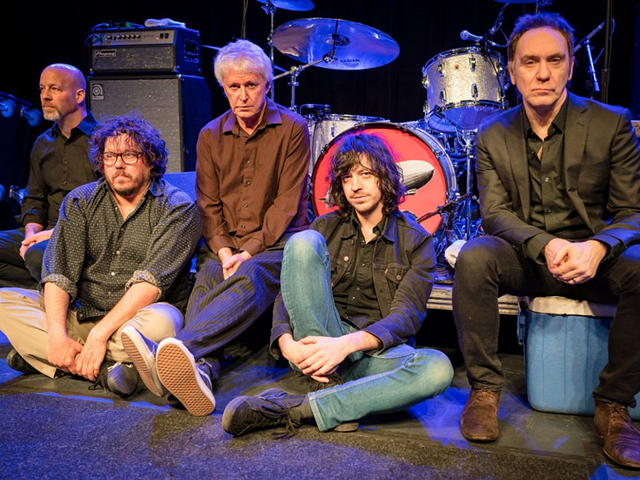
Tonight at Over-the-Rhine’s MOTR Pub, wildly impressive Cincy Soul/Pop/Rock quartet The Guitars celebrate the release of their new EP, High Action. Local Folk faves The Tillers open up the free show. Below is a review of the release, a slightly shorter version of which appeared in this week's CityBeat. You can also check out a track from the EP, so you can hear that I'm not lying when I say this is definitely one of the best releases by a local act this year.
I’m not going to pretend I knew what synesthesia meant before listening to former Cincinnati/current Columbus-based Hip Hop artist Ill Poetic’s latest release, Synesthesia: The Yellow Movement. But after diving into the seven-song EP (and looking up the title on dictionary.com), I discovered that synesthesia is something like a music-induced hallucination where the afflicted see music as colors, which is the perfect description the album has on its listeners.
In the short amount of time it takes to get through this EP (just under 24 minutes), Ill Po takes the listener on a funky, soulful trip through his creative process. On the first track, “Be Cool,” Po is kind of like Samuel L. Jackson in the diner scene of Pulp Fiction (without the Jheri curl), urging everyone from politicians to status rappers to just chill the fuck out and re-birth the cool like Miles Davis.
“Be Cool” then melts into a laid-back Soul cut, the highlight track “On My Way,” which features crooner CJ the Cynic. It’s probably just the producer in him, but Ill Poetic lets CJ take the reins of “On My Way” for almost the first two minutes before he brings his spoken-word lyrical styling to the production, which is reminiscent of early Kanye or Eryka Badu with, dare I say, an added dose of creativity.
The wait for Po's words is well worth it, however, when he spits that “Ghostface is my real estate agent." Again, I really don’t know what this means, but the sheer image of calling Sibcy Cline or Century 21 and getting Ghostface Killah on the other end of the receiver is pure imagery gold.
On the sixth track and first single off the EP, “Gone,” the song cleverly describes Po’s struggle to leave Cincinnati and pursue his dreams (his every body part attempting to convince his brain to dip-out), while the Jazz-style production makes the listener want to roll-up and take a road trip with this song on repeat.
The best part about this album, though, is when Ill says “You don’t have to be cool to listen to this; you don’t have to listen to this to be cool.” So for all the nerds, dorks, dweebs and losers out there looking for new music, have no fear. You don’t have to be cool to listen to this and listening to Ill Poetic won’t make you cool. But it surely couldn’t hurt.
Click below to preview and purchase Synesthesia: The Yellow Movement. For more on Ill Poetic, visit his official site here.
When veteran Cincinnati musician Zach Mechlem launched his latest project, Mack West, a few years ago, he didn’t just form a new band — he created a new genre. Calling the band’s sound “AltWestern” to describe the dusty, often cinematic quality of its modern American Roots music, Mack West released its self-titled debut two years ago to much acclaim and, given the evocative, visceral nature of the songs, attention from the world of music licensing. Tracks from the album were used on various promo spots and TV shows, including History Channel’s American Pickers.
Going into recording the follow-up, Mechlem and original members Will Campbell (bass) and Greg Slone (drums) bolstered their membership, adding guitarist (and album co-producer) Steve Wethington on guitar and violinist Annette Christianson. While the mood and spirit of the debut is still intact on the resulting album, The Goodnight Trail, Mack West’s sophomore effort doesn’t exactly expand on the trademark elements
From the moment Omar Rodriguez-Lopez and Cedric Bixler-Zavala left At the Drive-In to form The Mars Volta over a decade ago, the duo and their co-conspirators have made a conscious effort to challenge even their staunchest fans and completely confound their easily befuddled critics.
Finding their general direction somewhere in the floating nexus of Neo Prog, Metal, Math Rock, Fusion, Psychedelia, Electronica, Space Rock and Latin American music, The Mars Volta has applied their dizzyingly complex genre formula to straightforward album structures, song cycles and full blown concept albums with a constant eye towards disrupting music’s status quo, whatever that happens to be at any given moment.
The Mars Volta’s sixth full length, Noctourniquet, comes after a somewhat fractious period in the band’s history. Rodriguez-Lopez reportedly finished the music three years ago and argued with Bixler-Zavala about the time he was taking on lyrics and vocals; Rodriguez-Lopez eventually concentrated on his solo work as an alternative.
Noctourniquet finds The Mars Volta pursuing a sound they’ve characterized as Future Punk, a simplified (for them, anyway) version of their standard musical calculus. “Empty Vessels Make the Loudest Sound” is nearly a gorgeous Pop ballad with Pearl Jam’s heart and Metallica’s verve, while the album’s first single, “The Malkin Jewel” (listen below), has the reeling barroom swagger of Nick Cave covering Kurt Weill. Like 2009’s Octahedron, Noctourniquet offers moments of relative reflection (“Lapochka,” “Trinkets Pale of Moon”), serious intent (“In Absentia”), head spinning polyrhythms (“Molochwalker”) and blistering intensity (“Zed and Two Naughts”).
If Nocturniquet represents any kind of compromise for the Mars Volta, it has clearly been accomplished on their own singular terms.
A great concert can transform a venue and transport an audience to its own little world. Last night at Bogart's, Zach Condon and his very successful Indie-meets-World-music ensemble Beirut did both in front of a wildly appreciative, sold-out crowd.
For the past 40 years, Bonnie Raitt has made a success out of nearly everything she’s attempted. The red-haired daughter of a Broadway icon, Raitt was an unlikely champion of honest-to-Robert-Johnson Blues, but her incendiary guitar skills and unquenchable passion for the form won the respect of some of the genre’s legends; B.B. King famously cited Raitt as the greatest slide player ever.
When commercial recognition was slow to come, Raitt plugged away in spite of it, releasing a string of really good albums in the ’70s and ’80s (and to be honest, a few head-scratchers as well) and forging ahead when others might have thrown in the towel. She had opened herself to the possibilities offered by infusing her Blues translation with a hint of Pop with 1977’s Sweet Forgiveness, but the formula truly came to fruition on 1989’s Grammy-winning, platinum-selling Nick of Time, setting a course for the top of the charts over the next decade.
Although Raitt’s hot streak cooled slightly on both sides of the new millennium, she was inducted into the Rock and Roll Hall of Fame in 2000 and released a pair of excellent albums, 2002’s Silver Lining and 2005’s Souls Alike, one of the most raw, real and reflective albums in her catalog. It came at a tumultuous time for Raitt; she lost her mother in 2004 and her father the following year, leading her to largely retreat from music in order to process her grief. After further losing her brother and her best friend, Raitt returned to music with a vengeance; she did a massive tour with Taj Mahal in 2009 and she did sessions with artist/producer Joe Henry and on her own, resulting in Slipstream, one of the strongest albums in her canon and an amazing return to form.
Raitt signals that return with the one-two punch of opener “Used to Rule the World,” a slinky Jazz/Funk workout that simmers like a Dr. John gumbo, and her stellar Reggae spin on the late Gerry Rafferty’s “All Down the Line,” yet another prime example of Raitt’s incomparable ability to inhabit other songwriters’ material and make it her own (she claims just one co-writing credit on Slipstream, the funky choogle of “Down to You,” written with Randall Bramblett and George Marinelli). That ability is on full display here; Raitt’s down-and-dirty Blues take on Bob Dylan’s “Million Miles” is a marvel of interpretation, as is her atmospheric reading of “You Can’t Fail Me Now,” composed by Henry and Loudon Wainwright III. Raitt’s mastery of heartbreak songs continues with “Not Cause I Wanted To,” the flip side of her soul-wrenching take on “I Can’t Make You Love Me (penned by former Bengal Mike Reid).
Slipstream plays like a greatest hits albums of brand new songs, as Raitt reels off sterling examples of everything she does best, from slinky guitar leads and searing slide runs to heartfelt balladry and intuitive arrangements. Rolling Stone placed Raitt on their lists of 100 Greatest Guitarists and 100 Greatest Singers; Slipstream is the only supporting evidence required for that decision.
If Jack White is Indie Rock’s most prominent attention deficit multitasker, his Raconteurs bandmate Brendan Benson is his lesser known Indie Pop counterpart. The Detroit native’s band work with the Well Fed Boys and the Mood Elevator received good notices, but his solo output (1996’s One Mississippi, 2002’s Lapalco, 2005’s The Alternative to Love, 2009’s My Old, Familiar Friend) has garnered Benson a press kit filled with glowing reviews, a fair amount of TV/film placement, some impressive production work (The Greenhornes, Waxwings) and a devoted cult following. Benson’s success with The Raconteurs allows him the freedom to exhibit his unrestrained solo Pop id.
On What Kind of World, his fifth solo and first self-released album, Benson continues to cultivate a sonic identity that hovers in the vicinity of Jellyfish’s visceral Pop, Supergrass’ stratospherically melodic Rock, The Romantics’ irresistible dance floor Garage Pop and the Motor City’s soulful heart. The shift for Benson on What Kind of World is a refreshing lyrical honesty, inspired by his new wife and child, his new home in Nashville (and its inherent collaborators) and the awareness of advancing middle age.
Despite his marital and parental contentment, there’s still a bruised undercurrent to Benson’s observations (“Maybe she is bad for me, and I don’t care to see/Because what I want and what I need are the same for me/In the end”), but even his most caustic lyrical reflections are surrounded by a soundtrack that courses with Pop adrenaline (“Light of Day,” “Here in the Deadlights”) or aches with a sweet melancholy (“Pretty Baby,” the classic Elton John-tinged “On the Fence,” both duets with Pistol Annies’ Ashley Monroe).
Guests like Jon Auer, Ken Stringfellow (Posies/Big Star) and Sam Farrar (Phantom Planet) lend considerable weight to What Kind of World, but Benson doesn’t require star power to illuminate his work; he’s got quite enough Pop wattage of his own for that purpose.
Saturday, Apr 28: Jubal's Kin Festival Grounds
Saturday at MerleFest broke hard and cold. Our camping neighbors had an impromptu jam session at 3 a.m., which is to be expected when camping at a music festival geared towards people who not only love to watch and listen, but also play. It would have been one thing to hear the soft strains of a string jam or the gentle harmony of "Wildwood Flower," but some dude shouting the lyrics to "Whipping Post" over badly tuned guitars played really hard … not the thing mountain dreams are made from.
So I sat, at sun up, reading and drinking coffee, plotting revenge and the instead of taking my revenge, made the accused coffee, read some more and generally moved real slow. Crustymarhsmellowman. I did get to play a couple tunes with Pete McWhirter as he moved past to grab some coffee on his way to open his booth.
Then I moved real slow some more.
Really real slow.
After lunch, I decided to make an attempt to see some music.
I had already missed Jim Lauderdale at the Creekside Stage. To bad, I like some Jim Lauderdale and it would have been a nice wake up, but there you are. I saw on the schedule Jubal's Kin at the Dance Tent, looked at the clock and … damn missed that, too. But what ho! There they are on the schedule at the Americana Tent immediately following their Dance Tent set. It's a MerleFest miracle! I grabbed my camera and another cup of coffee and headed out.
Jubal's Kin, all nerves and bad house sound on Day 1, was all smooth and in good voice on Day 3. They filed the promise I thought I saw at the Cabin Stage on what always seems like an eternity ago and delivered a set full of vigor, with pristine sound delivered by the sound person. Their originals are fresh with sparse instrumentation and the kind of tight harmonies that only siblings can deliver. Never lyrically embarrassing with overplayed earnestness or too casual observation, they meld in with beautifully arranged and originally considered traditional tunes. There's "The Cuckoo," that ancient English broadside, rendered as if Billie Holiday had spent some time in the Eastern Kentucky mountains. "Buffalo Gal" was reconsidered as a pop tune with a well delivered encouragement to jump in on the chorus and sing along. Gaelanne's fiddle playing is absolutely gorgeous in a John Hartford/Matt Comb's kind of way, though leaning a bit heavier on the front of the beat as opposed to sitting in the pocket. And her banjo playing is just delicious. They added one more member for this set — "Uncle Joe" on pedal steel and fiddle. With "Baby Brother" on bass, Jubal's Kin appears to be a family band.
Satisfied my instincts were intact, I left the Americana Stage to catch some other music. I wondered into the Traditional Tent to catch some of mountain legend Red June. He was explaining to the audience what a jam session was. Have I mentioned the Traditional Tent smells like a barn? I don't think it's intentional, but the wet grass combined with an enclosed space has rendered an unfavorable impression. After the lesson on what a "jam" is, Red invited a local banjo player up to do a fiddle tune with the fiddle player who didn't bring a fiddle, but did bring a mandolin. Not to fear! You can play fiddle tunes on mandolin (or piano for that matter), so he requested the newest banjo player and the fiddle player with the mandolin decide on a tune they both knew and then play it. Five minutes of discussion and tuning followed. As I headed out of the tent I thought "Just like a jam session," and went down to the Creekside Cabin to catch the rest of the Snyder Family Band and the following act, Sierra Hull and Highway 111.
The Snyder Family Band is a family Bluegrass band (no irony at MerleFest!). Like all Bluegrass bands they have a banjo, sing harmonies and play Bluegrass. Of course they play it really well. People love them. Standing ovation.
I waited around for Sierra Hull and Highway 111 to take the stage. Sierra Hull, 5-foot-nothing and former wiz kid master of the mandolin is now a promising songwriter and ingenue. I'm familiar with this script and am bored not two minutes into the first song. Sigh. I stop in the field in front of the Watson Stage to hear some of "Assembly of Dust." Young Nashville Country script. Know it. Boring. Moving on.
It's coming up on 3 p.m. and time to give my sister a break in her booth in the Heritage Tent. Nancy Roberson is a weaver based out of Knoxville, Tenn. She's been showing, selling and demonstrating at MerleFest for about as long as there has been a MerleFest. She heads out for her afternoon nap (apparently a hardwired Roberson DNA trait) and I pleasantly meet the mass of retail customers streaming by and wondering into her booth.
Nancy makes shawls. Well kind of. Not only does she design each warp for the loom, but on these particular pieces of clothing, she has design the shawl itself. It's twisted, sewn up the back, and pulled over your head like a loose fitting sweater. The front gathers in soft bunches and hangs across the chest. The ladies love them. Woven of soft cotton and rayon with the occasional silk woven in for effect, the main color of each shawl is broken up with a rhythm of competing and sometimes complimentary colors. People can't help but be drawn in by the colors and when the reach out and touch them, you always get an "Oooooo, these feel so nice and are so beautiful." If you don't, it's a replicant — ready your phasers.
When Nancy returned, I checked the schedule and cheese whiz on a cracker if Jubal's Kin wasn't playing in the barn-like Traditional Tent. Finally a chance to catch this band in more intimate surroundings, smell be damned. I headed over, got there early and claimed a seat near the front. In short order the band was on stage, laughing and calling out songs. They moved though a load of traditional tunes, all rendered in a sweet, imaginative way, like "Dinah Blow Your Horn," with added lyrics and a new verse melody. The Carter Family's "No Depression" was delivered in soul rendering pain. About midway through the set, a guitar string broke enabling some spontaneous double fiddle and dancing. While the guitar player stepped off stage, "Uncle Joe" and Gaelanne tuned their fiddles and discussed which tune to play. In a matter of thirty seconds (this is no a jam session) launched into a Skillet Lickers number my dad probably danced to when he was their age. A friend jumped up on stage and launched into some spirited clogging. Not to be undone, "Baby Brother" put his bass down, peeled off his shoes and joined the Appalachian chorus line at the end of the stage with some well executed Buck Dancing.
Yes sir, these kids from Florida are the real shit. I've spent decades in front of poseurs, wannabees, shitty players and hopefuls. Using a foundation of traditional music obviously passed along from a family that loves this stuff at an early age, Jubal's Kin are making something very real, unique and personal that compels you to be a part.
This is why I come to MerleFest. Thanks, guys, for inviting me in.
Exhausted from a night of no sleep and a day of wandering and finding Jubal's Kin, I headed back to my book and coffee and called it a day.
In a discussion of lives spent making music, Ben Kweller’s name has to warrant a prominent mention. His father, a doctor who counted Nils Lofgren as a friend and former neighbor, taught Kweller how to play drums at age 8, which led to his first band, Radish, at 12, his first major label contract at 16, appearances on Conan O’Brien and David Letterman at 17 and the launch of his solo career at 19.
Since then, Kweller has released a quartet of acclaimed albums, collaborated with Ben Folds and Ben Lee (as The Bens, naturally) and Guster and toured with Evan Dando, Juliana Hatfield, Jeff Tweedy and Faith No More, among many others, a testament to Kweller’s musical adaptability and diverse appeal.
Kweller was talking about his fifth album, Go Fly a Kite, as long ago as fall 2010, describing it as nearly finished and ready to go. But a break from his longtime label, Dave Matthews’ ATO Records, caused Kweller to rethink Kite’s release date, pushing it close to a year beyond his original timing. Kweller must have used the time to set up his own label, Noise Company, because Go Fly a Kite sounds exactly as he outlined it a year and a half ago, namely a stripped down Power Pop/electric Folk hybrid that channels his early direction and perhaps signposts where he’s heading down the line.
Like Matthew Sweet or Fountains of Wayne, Kweller possesses an uncanny knack for setting relatively serious subjects to an infectiously catchy soundtrack. Kite is loaded with that bittersweet Pop ethic, particularly on simple but effective Pop/Rock fist pumpers like “Mean to Me” and the punchy “Justify Me.” Kweller’s early schooling in The Beatles and Hollies is woven into Kite’s 11 tracks, from the powerfully angsty “Jealous Girl” to the piano balladry and lilting orchestration of “The Rainbow,” but at the same time, he’s fully aware of his own creative identity and never gets lost in the forest of his influences.