Cincinnati Art Museum did well at this week's announcement of MacArthur Foundation $500,000 "genius grants" — one of the most prestigious in the world. Among the 24 recipients were artist Los Angeles artist Mark Bradford (pictured), who creates large-scale map-like collages out of everyday material and whose show Maps & Manifests was featured at Cincinnati Art Museum in 2008.
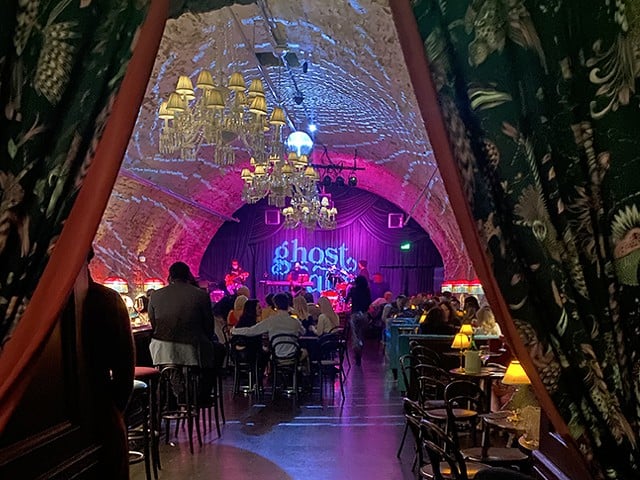
All rooms were jam-packed with people in imaginative costumes, and in the ballroom the DAAP Girls (outfitted for the night as the DAAP Witches) belted out a funky, soulful, garage-rock version of “Ghostbusters” far better than the cutesy original.
Best of all, for those who remember coughing and hacking their way through the old Southgate House, the place was non-smoking for this event and had signs up everywhere to enforce that. If it can keep up the pleasant smoke-free environment, Thompson House might just become the nightclub that counts in Greater Cincinnati. Still not sure if that will make me turn out for the upcoming Dying Fetus/Malignancy concert, but the place is definitely back on my radar.
Carnevil’s turnout also proved that FotoFocus, as an event, was on people’s radar. There had been some questioning of that earlier in the week, after moderate turnouts for two appearances by nationally significant photographers at Cincinnati Art Museum’s Fath Auditorium.
Laurel Nakadate gave the prestigious FotoFocus Lecture there on Oct. 24, presenting a slide show of the past 12 years of her sometimes-eyebrow-raising performative-video and still-photography work.
For one project, she wandered around truck stops and invited truckers to dance with her in their cabs. In another, she traveled across Canada by train and threw her underwear out the window each day, photographing the colorful results. (As far as I know, she did not get arrested for littering.) Someone asked about the inherent danger in some of her early work, which involved putting herself in erotic situations with strange men. “I look back at my early work and fear for my life,” she said. “But I’m really glad I made that work.”
Incidentally, one of her more recent projects — for which
she showed slides — was to photograph herself crying everyday for one year. The
“one year” motif seems to be such a strong one that some curator somewhere
should devote a show to its variations. There’s plenty of material right here.
At Michael Lowe’s Downtown gallery, site of the “Using Photography” FotoFocus
exhibit featuring work by 1970s-era (and beyond) Conceptual Artists, there is
an example of On Kawara’s “I Got Up” series. For 11 years (1968-1979), he sent
friend picture postcards stamped with the time that he arose each day.
And when Todd Pavlisko was in town last week to plan for his “Docent” rifle-firing project that occurred Monday at Cincinnati Art Museum, he said that one piece in his resultant museum show next year will be displaying all the loose change he’s collected in a year. (He will gold-plate the coinage.)
At the other appearance of a photographer at CAM last week, Chief Curator James Crump discussed the future of photography books with Minnesota photographer/publisher Alec Soth and Darius Himes, a gallerist whose Radius Books publishes unusual photography creations.
Some in the audience wished the event would have featured much more of Soth and his fascinating photojournalistic work. He did discuss a current project, in which he and Brad Zellar are photographing election-eve everyday life in Michigan for his LBM Dispatch, which tries to quickly publish and distribute photo essays. (The work will then be displayed at Detroit’s Cranbrook Institute.)
But Himes did express admiration for the strangest Conceptualist book project I’ve heard of in a long time. That would be photographer Mishka Henner’s printed-on-demand Astronomical, twelve 506-page volumes representing, in total, a scale model of the solar system from the sun to Pluto. Many of the pages are blank, representing the great distances between planets in space. Himes did not say if you must order the whole set or just your favorite volume, but you can find out more at here.
I was able to spend some time last week with Barry Andersen, photography professor emeritus at Northern Kentucky University who has been a strong, forceful advocate for the importance of this form as both an artistic medium and a critical societal observer. His own show, the now-concluded Sky, Earth and Sea at Notre Dame Academy in Park Hills, served as a satisfying retrospective of thirty years of his work. Especially lovely were his gorgeous aerial-shot” Cloudscapes,” vivid inkjet prints from negative scans.
And as a curator, he put together a superb, sadly also now-concluded, show at NKU called Reporting Back, which surveyed the work of 14 documentary photographers whose thematic interests covered the globe. Each one’s work was presented as a series of photographs, a thematically related suite, to remind us of the journalistic impact of the photo essay. Ashley Gilbertson’s quietly moving “Bedrooms of the Fallen” visited the bedrooms of soldiers slain in Iraq and Afghanistan. Their solemnity was balanced by Jim Dow’s colorful portraits of idiosyncratically appealing, retro-Americana buildings. You can learn more about the show — and be introduced to some fine photographers — here.
FotoFocus has the potential to shine a lens on fine Cincinnati photographers of the past whose reputations could use a revival. One of the best shows to achieve that goal this year was Cincinnati Museum Center’s Photographic Legacy of Paul Briol: 1909-1955, which closes Thursday. Briol’s black-and-white images of the rhythms and architecture of Cincinnati life have a dreamy beauty, partly because he was not adverse to stripping in more dramatic skies and otherwise heightening an image’s dramatic effect.
The populism and humanism in his work are evident — Lewis Hine perhaps was an inspiration. An elderly African-American couple sits while the woman peels a potato; children in what seems to be an aged urban schoolroom pose with their stuffed animals. Those, along with images of the skyline, a roller coaster, Fountain Square, the riverfront, Rabbit Hash, Ky.’s general store, give life to that era’s Cincinnati.
Actually, the photo of his that moved me the most was in a different show, the concluded Images of the Great Depression: A Documentary Portrait of Ohio. It was by far the best thing in that exhibit. His contribution, an extraordinarily composed photo from 1935 called “Waiting for Work,” shows the looming shadows of men against a room’s wall. A sign reads, “Dirty Men Will Not Be Sent Out.” Briol may have arranged this image rather than just observed and captured it, but no matter. It magnificently speaks to the despair and denigration that the Depression brought.
One hopes 2014’s FotoFocus will find room to spotlight a few other Cincinnati photographers of the past who could use rediscovery — perhaps Nelson Ronsheim or George Rosenthal. Or, if you have ideas, send them along to me at srosen@citybeat.com. In the Nov. 14 Big Picture column in CityBeat, I’ll address some suggestions for how we can keep the momentum going now that the interest level for photography has been raised.
Sunday afternoon, some 100 people (perhaps many more — it was really crowded!) gathered at the downtown studio of artist Tom Bacher for a surprise party celebrating Dennis Harrington's 30-plus years of work in Cincinnati's visual arts community. Harrington currently is director of the non-profit Weston Art Gallery in the Aronoff Center for the Arts. He was hired there in 1995, when it was new, by Sally LoveLarkin and became director upon her retirement in 1998.
It is also, like that other Oktoberfest (which actually occurs in September), fun. No, it doesn’t have the World’s Largest Chicken Dance, but it may have come up with something even better in Contained: Gateway Arts Festival, which opened last Saturday and continues with limited hours through Nov. 3.
It was produced by the Requiem Project, which is managing and hoping to restore Over-the-Rhine’s Emery Theatre (where there is a Mike Disfarmer photo exhibit that I blogged about last week). Saturday’s opening was hampered by cold weather that kept attendance small on the grounds of Grammer’s in Over-the-Rhine. (Grammer’s is a place that’s probably seen quite a few Oktoberfests in its day.) But the weather didn’t dampen the creative imagination that went into the event.
Using 11 trailer-size steel shipping containers as gallery walls, artists displayed their photography and video-based work, some interactive, as visitors wandered in and out. The standards were quite high and one project — David Rosenthal’s “Everything at Home Depot (Series)’’ — struck me as outstanding.
Installed in vertical pieces on fiberboard along the interior sides of the container, the color heat-transfer prints set out to do what the title suggests. In this environment — with the container’s metal sides, the wood floor and glaring fluorescent lights – the whole project looked just right — a melding of the artistic and the industrial, the soulful and the soulless. If this is part of a larger series (as the title suggests), it deserves to be seen in total. But one hopes future showings will get an environment as cool as this.
In a corner of the grounds, behind one crate and out of direct view, a band played suitably spacey music. After awhile, musicians moved atop a crate to play music with a pronounced electronic component. Meanwhile, video projections were displayed high off the building’s sides — you could see the images when approaching the site and it was really exciting.
The whole festival, itself, worked as an art installation. It will be open again this Friday from 6-10 p.m. (it’s ideal at dark), 2-5 p.m. Saturday and Nov. 3 by appointment at info@emerytheatre.com. It’s definitely worth a visit, even if not that easy to get to.
Another show you need to see — partly because of its excellence and partly because it’s in a space rarely open to the public — is the Using Photography exhibit at downtown’s Michael Lowe Gallery. He is a private dealer, so it’s a treat to see his elegant, uncluttered two-floor gallery open to the public. Drawing on his own collection, he’s put together a show that works as both top-notch fine-art photography and as a historical exhibition.
In this case, the history that the show addresses is that of the conceptual/performance art world of the 1970s. Pivotal names in international contemporary art’s development are represented here — Marina Abramovic, Vito Acconci, Gerhard Richter, Michael Kelly, Ed Ruscha, Gilbert and George and many more.
With the richness of work represented, and it way it stretches our definition of photography and time-based art, it’s one of FotoFocus’ best shows. To just pick one piece, I was especially moved by Christian Boltanski’s five touched-up photographs comprising 1974’s “Anniversaire,” or “The Birthday.” I am used to the French artist’s solemn, sobering, heart-rending installations that use photography to remember the Holocaust. They are so strong you wonder if they must drain the artist of all joie de vivre. Yet here he is happy in this work, and the meaning of that happiness is revelatory if you know his history. Even if you don’t, it’s a generous and warm piece.
This show originally was going to be open just briefly, but Lowe has agreed to stay open noon-4 p.m. weekdays through the end of the month. His gallery is at 905 Vine St. Plan a downtown lunch trip around it.
Meanwhile, only up through this Thursday is Photogenus at the Reed Gallery inside University of Cincinnati’s College of Design, Art, Architecture & Planning. Put together by Jordan Tate, DAAP photography professor, and gallery director Aaron Cowan, this looks at how today’s international artists use photography in a digital age.
It’s a nice companion to Lowe’s show, as one chronicles breakthroughs from the 1970s (some of which we’re still trying to understand) and one shows how today’s international artists are using photography to make new breakthroughs. Much of it is quite out-there and left me quizzical about individual work’s obscure intent and technique. But some were very striking, like Anthony Lepore’s pairing of a photo (an archival ink print) of a salt field with a piece of carpet of roughly the same color.
I had written earlier about how eager I was to see Nancy Rexroth’s photographs at downtown’s YWCA Women’s Art Gallery as part of FotoFocus. The show consists of previously unprinted images from her influential Iowa project of the early 1970s — she used a toy camera to capture fleeting glimpses of everyday life in rural Ohio.
There was always the chance the black-and-white work had
been left unprinted for a reason all these decades, but I’m happy to report
it’s an excellent, evocative show — underscoring just how strong a body of work
Iowa is. Besides the ghostly “Clara
in the Closet, Carpenter, OH,” previously published in CityBeat, I also loved
“House Vibration, Dayton, OH, 1976,” in which the blurry focus produces an
unsteady image that makes one think an earthquake is occurring. It’s a great
metaphor for the here-today-gone-tomorrow nature of life. This show will be up
through Jan. 10 — Rexroth shares the space with Judi Parks and Jane Alden
Stevens.
I’m smarting from an Oct. 21 article in The New York Times by Nicolai Ouroussoff called “Art and Commerce Canoodling in Central Park.” The piece reviews the most recent stop of the Chanel Pavilion designed by Zaha Hadid (of local reputation for designing the Contemporary Arts Center) in loose collaboration with Karl Lagerfeld. I won’t recount all my bruises from Ouroussoff’s varied grievances; you can read through them here.
Starting at 5 p.m. this Friday, the Clifton Cultural Arts Center will hold a ceremony for the lighting of its historic 1906 Clifton School Building. The actual lighting is slated for 6 p.m. The new exterior lighting has been provided by funds raised by the CCAC, with and installation donated by Architectural Landscape Lighting & Design of Miamitown.
It's official: the Contemporary Arts Center today announced that hot Shepard Fairey retrospective currently at Boston's Institute for Contemporary Art will be coming there for the 2009-10 season. Fairey, creator of the famous Obama posters, will also come when the show opens here to do public art and participate in CAC events.
I took in several art shows that I recommend, for various reasons, this past weekend.
At designsmithgallery (1342 Main St., Over-the-Rhine), a selection of gorgeous vintage platinum and oil-pigment prints from Doris Ulmann, the early-20th-century photographer who moved from more formal and traditionalist pictorialism toward a newer documentary style, are on display. These once belonged to the Folk singer and Folk-song collector John Jacob Niles, a friend of hers, and are from his estate. The show will be up through Nov. 22 and, while small, is well worth a visit. (www.designsmithgallery.com.)
On Saturday night, I attended the opening of the strange — and, in its way, quite fun — I Will Never Recover From This Macaroon by artist/CityBeat contributor Matt Morris at Semantics Gallery (1107 Harrison Ave., Brighton). The space inside and out is filled with installations and interventions — olfactory as well as visual — that connote the debris of a very conceptual house party where smart people put a lot of thought into how they break and discard things. It's up through Oct. 25 and is well worth a visit. And Morris' tissue drawings are extremely intriguing. At 7 p.m. this Saturday, there will be a reading of experimental texts.
Finally, while some of The Carnegie Galleries' The Bold, The Beautiful and The Bizarre show of work by five artists left me admiring the craftsmanship but not feeling anything about the inspiration, Brenda Tarbell's amazingly beautiful ceramics need to be seen. They seem as shimmeringly alive as underseas crustacians in their organic shapes and textures. It takes considerable willpower to resist handling them; they have the alluring power of a visit to the sea. The exhibition only runs until this Friday, so stop by at 1028 Scott Blvd. in Covington (www.the carnegie.com).
Charles Woodman, a Cincinnati artist and assistant professor of electronic art at DAAP, reportedly has a knockout five-screen video installation at the new group show The Romance of the Road: Photographs in Search of the Promised Land at Charlotte's Light Factory Contemporary Museum of Photography and Film.