The Republican head of Hamilton County’s governing board outlined his own alternative for a 2013 budget on Monday, proposing an austere path forward after rejecting other budgets that would raise some taxes.
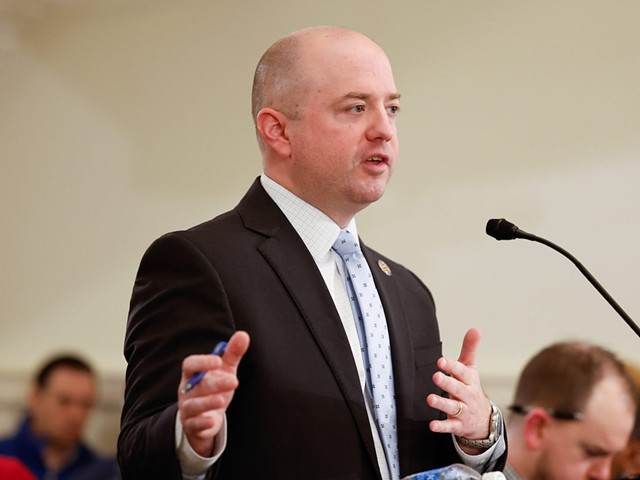
Board of County Commissioners President Greg Hartmann said his proposed budget would reduce the size of county government by 30 percent, compared to five years ago. He said he wants the board to approve a budget before the Thanksgiving holiday.
“It is a budget of austerity and investment in growth,” Hartmann said.
He added, “It is a structurally-balanced budget,” that doesn’t use one-time sources of cash to make up for shortfalls.
Hartmann’s proposed budget would cut the Sheriff’s Department by about $57,000 or 0.01 percent from 2012 levels; reduce the coroner’s appropriation by 3 percent or $99,000; cut economic development by 5 percent; cut 5 percent from adult criminal courts; and reduce subsidies to the Communications Center and Sheriff’s Department.
Hartmann stressed that it is important to fund public safety as fully as allowable in these tough economic times, as economic development is not possible without it.
Hartmann’s budget comes after commissioners rejected three proposals from County Administrator Christian Sigman.
Sigman proposed $18.7 million in cuts, which Hartmann’s budget maintained in addition to his own reductions.
Two of Sigman’s proposals involved increasing the sales tax to balance the budget.
Fellow Republican Commissioner Chris Monzel said he supports Hartmann’s efforts at austerity, but is working on his own budget proposal as well.
“An austerity budget is the way we’re going to go, and it’s going to be hard,” he said.
The board’s sole Democrat, Todd Portune, said he too is working on his own proposal that he had hoped to have prepared for the Nov. 5 meeting, but was still making tweaks and hoped to present it by the following week.
He hinted that the results of Election Day might impact how he crafts his budget proposal.
“Tomorrow’s results may have an impact as well on the budget that I present as it relates as well to those who are running for county seats,” Portune said. “We have in some cases two very different visions in terms of solutions.”
Both he and Hartmann are up for re-election. Portune is running against Libertarian Bob Frey. Neither candidate has a major party challenger.
Hartmann, who has actively campaigned for Republican presidential candidate Mitt Romney, had a joke in response to Portune’s waiting for the election results.
“I thought you were predicting Romney’s win would make the economy go on the right track,” Hartmann cracked. “I was thinking that’s what you were going to go with.”
Just two days before the general election, President Barack Obama made his case to 13,500 people packed into the University of Cincinnati’s Fifth Third Arena and 2,000 in an overflow room.
Obama cast the race in comparisons to the previous two
presidents, comparing his policies with those of Bill Clinton and equating Republican
challenger Mitt Romney’s plans with those of George W. Bush.
“So stay with me then,” Obama said. “We’ve got ideas that work,
and we’ve got ideas that don’t work, so the choice should be pretty clear.”
With less than 48 hours before polls open on Election Day,
a Reuters/Ipsos daily tracking poll had Obama and his Republican challenger locked
in a statistical dead heat. However the same poll showed Obama with a slight
edge in Ohio, up 48 percent to Romney’s 44 percent.
Obama touted his first-term accomplishments, including ending the
war in Iraq; ending Don’t Ask Don’t Tell, the policy preventing homosexuals
from serving openly in the military; and overhauling the country’s health care
system.
“It’s not just about policy, it’s about trust. Who do you trust?”
the president asked, flanked by a sea of supporters waving blue “Forward”
signs.
“Look, Ohio, you know me by now. You may not agree with every
decision I’ve made, Michelle doesn’t always agree with me. You may be
frustrated with the pace of change … but I say what I mean and I mean what I
say.”
Nonpartisan political fact-checker PolitiFact on Nov. 3 took a
look at Obama’s record on keeping his campaign promises from 2008. The group rated
38 percent as Kept, 16 percent Compromised and 17 percent Broken.
Twice during his speech the president was interrupted by audience
members shouting from the stands.
The first was a man on the balcony level of the arena
interrupted, shouting anti-abortion slogans and waving a sign showing mutilated
fetuses before being dragged out by about five law enforcement officers. Both were
drowned out by supporters.
Music legend Stevie Wonder opened the rally for Obama, playing a
number of his hits, opening up “Superstition” with a refrain of “on the right
track, can’t go back.”
Wonder discussed abortion policy between songs and urged Ohioans
who had not already voted to do so either early on Monday or Election Day.
So far, 28 percent of Ohio voters have already cast their
ballots. CNN reports that those votes favor Obama 63/35, according to public
polling.
Meanwhile on Sunday, Romney campaigned before an estimated crowd
of 25,000 in Pennsylvania, according to the Secret Service.
Political rallies always draw a number of the loyal opposition,
and this late-evening appearance was no different. Only five people protested
near the line to the arena, but what they lacked in number they attempted to
make up for in message.
One large sign read “Obama: 666” and another “Obama is the Beast,”
alluding to a character in the Christian Biblical book of Revelation.
A man who only identified himself as Brooks carried a large
anti-abortion sign that showed pieces of a dismembered fetus.
“I’m here to stand up for the innocent blood that has been shed
in this land to the tune of 56 million,” Brooks said. He said he was opposed to
the politics of both major party presidential candidates.
“I pray for Barack Obama because his beliefs are of the
Antichrist, just like Romney,” Brooks said.
Brooks said his message for those in line was for them to vote
for Jesus — not on the ballot, but through their actions and through candidates
that espoused Christian beliefs.
“Obama is not going to change things, Romney is not going to
change things,” Brooks said. “In the last days there are many Christs, but not
the Christ of the Bible. The Christ of the Bible is not for killing children,
is not for homosexual marriage.”
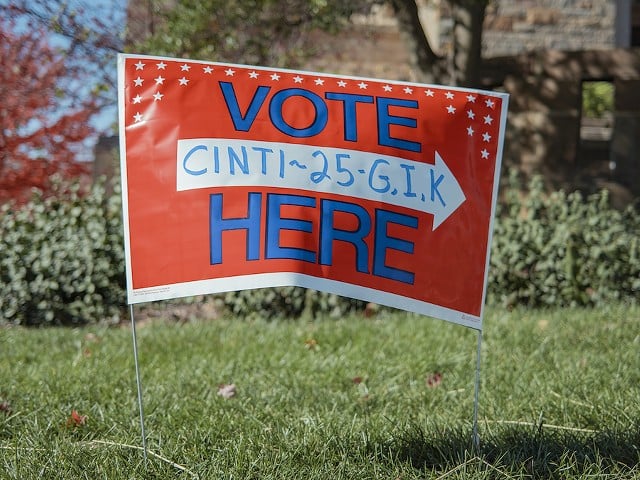
In-person early voting is underway in Ohio. Find your nearest polling booth here.
The last debate for Ohio’s U.S. Senate seat took place last
night. The debate between Democratic incumbent Sherrod Brown and
Republican challenger Josh Mandel mostly covered old ground, but the
candidates did draw contrasting details on keeping Social Security
solvent. Mandel favored raising the eligibility age on younger generations, while Brown favored
raising the payroll tax cap. Currently, Brown leads
Mandel in aggregate polling by 5.2 points.
Mitt Romney was in town yesterday. In his speech, he
criticized the president’s policies and campaign rhetoric and touted
support for small businesses. The Cincinnati visit was the first stop of
a two-day tour of Ohio, which is the most important swing state in the
presidential race. But senior Republican officials are apparently
worried Romney has leveled off in the state, which could cost Romney the
Electoral College and election. President Barack Obama is
expected to visit Cincinnati on Halloween. In aggregate polling, Obama
is ahead in Ohio by 2.1 points, and Romney is up nationally by 0.9
points.
The American Civil Liberties Union (ACLU) of Ohio says the
use of seclusion rooms in Ohio schools should be phased out
by 2016. The Ohio Department of Education and Ohio Board of Education
are currently taking feedback on a new policy draft that says schools
can only use seclusion rooms in cases of “immediate threat of physical
harm,” but the policy only affects traditional public schools, not
charter schools, private schools or educational service centers.
Seclusion rooms are intended to restrain children who become violent,
but recent investigations found the rooms are used to punish children or
as a convenience for staff. Currently, Ohio has no state laws
overseeing seclusion rooms, and the Department of Education and Board of
Education provide little guidance and oversight regarding seclusion
rooms.
The Metropolitan Sewer District of Greater Cincinnati and a City Council task force have a plan to make Cincinnati’s water infrastructure a little greener.
A study found Cincinnati hospitals are good with heart patients but not-so-good with knee surgery. The names of the hospitals that were looked at were not revealed in the study, however.
An economist at PNC Financial Services Group says 10,000 jobs will be added in Cincinnati in 2013.
Cincinnati-based Procter & Gamble has new details about its effort to reduce costs and make operations more productive. The company announced a “productivity council” that will look at “the next round of productivity improvements.” The company also said it will reach 4,200 out of 5,700 job cuts by the end of October as part of a $10 billion restructuring program announced in February.
The world just got a little sadder. Chemicals in couches could be making people fatter.
On the bright side, we now know how to properly butcher and eat a triceratops.
Democratic incumbent Sherrod Brown and Republican challenger Josh Mandel met once again Thursday night for a debate to see who is more qualified for Ohio’s U.S. Senate seat. The candidates were a bit less feisty in their final debate, but the substance behind their words was fairly similar to the past two debates.
Mandel spent a bit less time attacking Brown for “Washington speak,” and Brown spent a bit less time attacking Mandel for dishonesty. However, Mandel did spend a bit more time attacking Brown for being a “career politician,” and both candidates criticized each other for voting along party lines.
For the most part, the debate treaded ground covered in the first debate and second debate. CityBeat covered those face-offs in-depth here: first debate and second debate.
Some new details did emerge when Brown and Mandel discussed Social Security. Mandel clarified he would raise the eligibility age for Social Security and Medicare for those around his age — 35 — and younger. To justify the raise, he said life expectancy has grown since those laws were first put into place. He also claimed, “If we maintain the status quo, which is the way of Washington, there will be no Medicare or Social Security.”
Brown responded by saying he wouldn’t raise the eligibility age or reduce benefits, but he would increase the payroll tax cap.
In the case of Mandel’s proposal, there is some important context missing. While it’s true life expectancy has increased in the U.S., it has not increased at the same level for everyone. A 2008 study by the Congressional Budget Office found life expectancy is lagging for low-income individuals, while it’s steadily rising for the wealthiest Americans. A 2006 study published in the International Journal of Epidemiology had similar findings. These studies show increases in the average life expectancy may not be reflective of what’s actually happening within the poor and even middle class. In other words, raising the eligibility age to match the rise in life expectancy could disproportionately hurt the lower classes.
There are also some holes in gauging the eligibility age for entitlement programs with a rise in the average life expectancy. Social Security was enacted in 1935. Between the law passing and 2007, the U.S. child mortality rate dropped about 3.3 percent per year for children between the ages of one and four, according to a study from the U.S. Department of Health and Human Services. This large drop in child mortality rate could be exaggerating gains in life expectancy, which is an average that takes into account the age of deceased children.
Mandel’s implication that raising the eligibility age is the only way to keep Social Security solvent is also misleading. Currently, the payroll tax is set up so it only taxes the first $110,100 of everyone’s income. A Congressional Research Service study from 2010 found eliminating the cap would keep the Social Security Trust Funds solvent for the next 75 years. The downside is this would raise taxes for anyone making more than $110,100. Still, the fact eliminating the cap would extend the trust funds’ solvency shows there are other options, and it shows Brown’s idea of increasing the cap has some fiscal merit.
However, Mandel would not be able to take Brown’s approach because it would mean raising taxes, which Mandel vowed to not do under any circumstance when he signed lobbyist Grover Norquist’s anti-tax pledge.
For the final debate, Mandel and Brown followed similar paths as before and even recited some of the exact same lines. At this point, the candidates have painted clear contrasts. With three debates and a year of campaigning behind them, it’s now clear Brown is mostly the liberal, Democratic choice and Mandel is mostly the conservative, Republican choice.
As cities rush to solve major problems with water infrastructure, newer technologies are being touted by city agencies as cheaper, cleaner solutions. In two different local projects, the Metropolitan Sewer District of Greater Cincinnati (MSD) and a City Council task force are looking into green ways to solve the city’s water needs.
On Wednesday, CityBeat covered some of the benefits and downsides of green water infrastructure. According to the report reviewed Wednesday, green water infrastructure is cheaper and does create a boon of jobs, but it faces some funding and education problems. However, it was unclear how the green ideas would translate into Cincinnati.
Tony Parrott, executive director of MSD, says despite the challenges, green infrastructure is clearly the cheaper option. The organization is partnering with local organizations to adopt a series of new projects — among them, green roofs, rain gardens, wetlands — to meet a new federal mandate that requires MSD to reduce the amount of sewer overflow that makes it into local rivers and streams.
“That is a very costly mandate,” he says. “Our belief is that green infrastructure and sustainable infrastructure will allow us to achieve a lot of those objectives a lot cheaper than your conventional deep tunnel systems or other gray type of infrastructure.”
Of course, conventional — or “gray” — infrastructure still
has its place, but adopting a hybrid of green and gray infrastructure
or just green infrastructure in some areas was found to be cheaper in
MSD analyses, according to Parrott.
Plans are already being executed. On top of the smaller projects that slow the flow of storm water into sewer systems, MSD is also taking what Parrott calls a “large-scale approach to resurrect or daylight former streams and creeks that were buried over 150 years ago.” This approach will rely on the new waterways to redirect storm water so it doesn’t threaten to flood sewers and cause sewer overflow, Parrott says.
The programs are being approached in a “holistic way,” according to Parrott. MSD intends to refine and reiterate on what works as the programs develop. However, that comes with challenges when setting goals and asking for funding.
“We think that if you’re going to use a more integrated approach, it may require us to ask for more time to get some of these projects done and in the ground and then see how effective they are,” Parrott says.
If it all plays out, the ongoing maintenance required by the green approach could be good for the local economy, according to Parrott: “With the green and sustainable infrastructure, you’re creating a new class of what we call green jobs for maintenance. The majority of those jobs are something local folks can do as opposed to the conventional process.” Additionally, the green jobs also tend to benefit “disadvantaged communities” more than conventional jobs, according to Parrott.
The argument is essentially what Jeremy Hays, chief strategist for state and local initiatives at Green For All, told CityBeat on Wednesday. Since the green jobs require less education and training, they’re more accessible to “disadvantaged workers,” according to Hays: “They require some training and some skills, but not four years’ worth because it’s skills that you can get at a community college or even on the job.”
While MSD fully encourages the use of rain barrels, recycling will not be a top priority for MSD’s programs. Instead, that priority goes to the Rainwater Harvesting Task Force, a City Council task force intended to find ways to reform the city’s plumbing code to make harvesting and recycling rainwater a possibility.
Bob Knight, a member of the task force, says there is already a model in place the city can use. The task force is looking into adopting the International Green Construction Code (IGCC) in Cincinnati. The code will “prescriptively tell” architects and engineers how to design a rainwater harvesting system. In other words, IGCC would set a standard for the city.
Deciding on this code was not without challenges. At first, the task force wasn’t even sure if it could dictate how rainwater is harvested and recycled. The first question Knight had to ask was, “Who has that authority?” What it found is a mix of local agencies — Greater Cincinnati Water Works, MSD and Cincinnati Department of Planning — will all have to work together to implement the city’s new code.
The task force hopes to give its findings to Quality of Life Committee, which is led by Vice Mayor Roxanne Qualls, by the end of November.
In-person early voting is underway in Ohio. Find your nearest polling booth here.
The final debate for Ohio’s U.S. Senate seat is tonight. Democratic incumbent Sherrod Brown and Republican challenger Josh Mandel will meet in Cincinnati to continue a feisty exchange of ideas and sometimes insults. In the last debate, the candidates drew sharp contrasts on policy, which CityBeat covered in-depth here. The final debate will be tonight at 7 p.m. on all Ohio NBC news stations, including WLWT.com. In aggregate polling, Brown is currently up 5.2 points against Mandel.
Want to see what a biased headline from a local newspaper looks like? Here you go, from Business Courier:
Romney win would boost economy, economist says. Strangely enough, the article says re-electing President Barack Obama could also lift the economy, which makes the misleading headline even worse. Unfortunately for the newspaper, Obama is currently leading by 2.1 points in
Ohio against Mitt Romney, and the state will play a pivotal role in the
election. Romney is leading by 0.6 points nationally.
A group is trying to convince Cincinnatians to vote no on Issue 4. The initiative, which is on 2012’s ballot, would extend City Council terms from two to four years. Supporters of Issue 4 say it lets City Council focus more on passing laws and less on campaigning, but opponents say it makes it more difficult to hold City Council accountable.
Ohio Supreme Court Justice Robert Cupp is distancing himself from a TV ad put out by the Ohio Republican Party that depicts his Democratic opponent, William O’Neill, as sympathetic to rapists. Liberal blog Plunderbund called the ad “tone deaf,” referencing recent instances of Republican senatorial candidates turning rape into a legitimate issue. The Republican Senate candidate for Indiana, Richard Mourdock, recently said during a debate, “I think that even when life begins in that horrible situation of rape, that it is something that God intended to happen.” Previously, the Republican Senate candidate for Missouri, Todd Akin, told reporters when discussing pregnancy caused by rape, “If it’s a legitimate rape, the female body has ways to try to shut that whole thing down.”
CityBeat looked at some of the benefits and downsides of green water infrastructure yesterday. Basically, it’s going to produce more jobs and economic growth, but it’s going to require long-term commitment and education. Later today, CityBeat will be talking to some city officials of how that green infrastructure can be adopted in Cincinnati.
Hamilton County’s budget is tight, and that means no wage hike for county workers anytime soon, according to Hamilton County Commission President Greg Hartmann.
Gov. John Kasich is taking his time in filling an open Board of Education seat. Rob Nichols, Kasich’s spokesperson, says, “We just want to get the right person.” But state law requires the seat be filled within 30 days, and the seat has been vacant for a month.
An Ohio judge said provisional ballots cast in the wrong precinct and polling location must still be counted.
Cincinnati-based Procter & Gamble beat Wall Street expectations, easing concerns from skeptical investors.
Huntington National Bank is relaunching its credit card business in a move that will produce 250 new jobs, and Greater Cincinnati is expected to land some of those jobs.
Ohio is getting a little love from Airbus. The aerospace company will be getting more of its parts from Ohio manufacturers. Cincinnati-based GE Aviation is already Airbus’ biggest U.S. supplier.
A new health care report found health providers often
cover up mistakes in fear of retaliation. The report also found health
care has been slow at embracing the “culture of safety.”
Apparently, strict parents raise conservative kids.
Ohioans might not give it much thought outside of paying the water bill, but better water infrastructure can make cities more efficient, healthier and cleaner. That’s why Green For All, a group that promotes clean energy initiatives, is now focusing on cleaner, greener water infrastructure.
A little-known green conference took place in Cincinnati Oct. 15-17. The Urban Water Sustainability Leadership Conference was in town on those three days, and it brought together leaders from around the U.S. to discuss sustainable water programs for cities. The conference mostly focused on policy ideas, success stories and challenges faced by modern water infrastructure.
For Green For All, attending the conference was about establishing one key element that isn’t often associated with water and sewer systems: jobs. Jeremy Hays, chief strategist for state and local initiatives at Green For All, says this was the focus for his organization.
Hays says it’s important for groups promoting better water infrastructure to include the jobs aspect of the equation. To Hays, while it’s certainly important for cities to establish cleaner and more efficient initiatives, it’s also important to get people back to work. He worries this side of water infrastructure policies are “often left out.”
He points to a report released by Green For All during last year’s conference. The report looked at how investing the $188.4 billion suggested by the Environmental Protection Agency (EPA) to manage rainwater and preserve water quality in the U.S. would translate into economic development and jobs: “We find that an investment of $188.4 billion spread equally over the next five years would generate $265.6 billion in economic activity and create close to 1.9 million jobs.”
To accomplish that robust growth and job development, the report claims infrastructure would have to mimic “natural solutions.” It would focus on green roofs, which are rooftop areas with planted vegetation; urban tree planting; rain gardens, which are areas that use vegetation to reduce storm water runoff; bioswales, which are shallow, vegetated depressions that catch rainwater and redirect it; constructed wetlands; permeable pavements, which are special pavements that allow water to pass through more easily; rainwater harvesting, which uses rain barrels and other storage devices to collect and recycle rainwater; and green alleys, which reduce paved or impervious surfaces with vegetation that reduces storm water runoff.
The report says constructing and maintaining these sorts of programs would produce massive growth, especially in comparison to other programs already supported by presidential candidates and the federal government: “Infrastructure investments create over 16 percent more jobs dollar-for-dollar than a payroll tax holiday, nearly 40 percent more jobs than an across-the-board tax cut, and over five times as many jobs as temporary business tax cuts.”
Hays says the jobs created also don’t have barriers that keep them inaccessible to what he calls “disadvantaged workers”: “A lot of these jobs that we’re focused on in infrastructure, especially green infrastructure, are much more accessible. They require some training and some skills, but not four years’ worth because it’s skills that you can get at a community college or even on the job.”
Beyond jobs, Green For All supports greener infrastructure due to its health benefits. Hays cited heat waves as one example. He says the extra plants and vegetation planted to support green infrastructure can help absorb heat that’s typically contained by cities.
Hays’ example has a lot of science to stand on. The extra heating effect in cities, known as the urban heat island effect, is caused because cities have more buildings and pavements that absorb and contain heat, more pollution that warms the air and fewer plants that enable evaporation and transpiration through a process called evapotranspiration. The EPA promotes green roofs in order to help combat the urban heat island effect.
Hays says green infrastructure also creates cleaner air because trees capture carbon dioxide and break it down to oxygen. The work of the extra trees can also help reduce global warming, although Hays cautions that the ultimate effect is probably “relatively small.”
But those are only some of the advantages Hays sees in green infrastructure. He says green infrastructure is more resilient against volatile weather events caused by global warming. With green infrastructure, storm water can be managed by systems that collect and actually utilize rainwater to harvest clean water. Even in a world without climate change, that storm water management also reduces water contamination by reducing sewer overflow caused by storm water floods, according to Hays.
However, green infrastructure is not without its problems. Hays acknowledges there are some problems with infrastructure systems that require more year-over-year maintenance: “The green and conventional approach is more cost effective over time, but the way you have to spend money is different. So we need to look at the way we finance infrastructure, and make sure we keep up with innovative technologies.”
Specifically, green infrastructure relies less on big capital investments and more on ongoing maintenance costs. Hays insists the green infrastructure saves money in the long term with efficiency and by making more use out of natural resources, and the Green For All report supports his claim. But it is more difficult to get a city or state legislator to support long-term funding than it is to get them to support big capital expenditures, Hays says.
Education is also a problem. To a lot of people, the green infrastructure on rooftops and other city areas might seem like “pocket parks,” says Hays. But these areas are nothing like parks; they are meant to absorb and collect rainwater. If the public isn’t educated properly, there could be some confusion as to why the supposed “pocket parks” are flooded so often. Providing that education is going to be another big challenge for public officials adopting green infrastructure, according to Hays.
So what, if anything, is Cincinnati doing to adopt these
technologies? In the past, city legislators have looked into rainwater
harvesting systems, but not much information is out there. On Thursday, CityBeat will talk to city officials to see how Cincinnati is moving forward.
In-person early voting is underway in Ohio. Find your nearest polling booth here.
A City Council committee approved $13.5 million that will be going to Over-the-Rhine development. Of that money, $6 million will go to the second phase of the Mercer Commons project, which is being developed by Cincinnati Center City Development Corporation (3CDC). The rest will help 3CDC redevelop 18 different buildings that are mostly around Washington Park. City Council will vote on the funding today.
Cincinnati’s unemployment rate dropped to 6.9 percent, but the drop was mostly attributed to people leaving the labor force. Between September 2011 and September 2012, Cincinnati’s labor force has actually shrunk. Still, more people were employed in September 2012 than were employed in September 2011.
The Port of Greater Cincinnati Development Authority is asking Cincinnati for $8.5 million to secure a Jordan Crossing shopping center project at Bond Hill. The funds would pay for the demolition, site preparation, marketing and redevelopment of the project.
In the second wave of interim results from an ongoing investigation into Ohio schools’ attendance data reporting, State Auditor Dave Yost found no evidence of attendance scrubbing in schools with levies on the 2012 ballot. The investigation included Cincinnati Public Schools, which means CPS was found to be clean. In a statement, Yost said, “I’m surprised and pleased. To have zero incidents of ‘scrubbing’ is encouraging news.” The full findings for both interim reports can be found here.
Clifton is set to get a neighborhood grocery store soon. The neighborhood has been without one since January 2011. City Council’s Budget and Finance Committee helped spur the new project with a tax abatement program.The Hamilton County Board of Commissioners held a budget hearing yesterday, but not much new information came out. Board President Greg Hartmann insists public safety is a priority, but he says the sheriff’s office will have to deal with some across-the-board cuts. The cuts won’t include closing the jail, decreasing courtroom security or eliminating contracts with townships for patrols. The board has two more public meetings on Oct. 29 and 30.
The controversial billboards accused of attempting to suppress voters are being taken down by Norton Outdoor Advertising, the Cincinnati company that hosted the billboards. Meanwhile, P.G. Sittenfeld and Lamar Advertising Company, a different billboard company, are putting up 10 billboards that read, “Hey Cincinnati, voting is a right not a crime!” The new billboards are supposed to encourage voting.
The University of Cincinnati has a new president: Santa Ono. The official promotion was unanimously approved by the UC Board of Trustees. Ono has been serving as interim president since Aug. 21, when former President Greg Williams suddenly resigned due to “personal reasons.”
The Cincinnati Enquirer is being accused of age discrimination in a recently amended lawsuit. In the lawsuit, eight former employees claim they were fired and replaced with younger, less qualified employees.
A new rumor is going around that says it’s possible to tamper with voting results, but fact checkers and election officials are saying it’s not possible. The rumors started due to the Romneys’ investments in an electronic voting company.
The Ohio Environmental Protection Agency is celebrating its 40th anniversary. Here is a list of some of the department’s accomplishments: The amount of rivers meeting aquatic life standards went from 21 to 89 percent between the 1980s and today, carbon monoxide in the air is down 80 percent since the 1970s, sulfur dioxide is down 71 percent, lead is down 95 percent and 99 percent of community public water systems now meet health standards, up from 85 percent in 1993.
Miami University says it will discipline two students responsible for putting up an offensive flyer about getting away with rape in a coed dorm bathroom.
Metro revealed its plans for an Uptown Transit District. The district, which will cost Metro $6.9 million, is meant to better suit the needs and growth of Uptown.
Two Democratic state lawmakers are planning legislation to slow down the privatization of the Ohio Turnpike. Gov. John Kasich’s administration is currently paying $3.4 million to KPMG, a private consulting and accounting firm, to study whether leasing the turnpike to the highest private bidder would benefit the state. Kasich says he could use the money saved for transportation projects all around the state. But northern Ohio residents do not seem happy with giving up a valuable asset they helped invest in, especially if the revenue from the Ohio Turnpike goes to regions outside of northern Ohio.
There's more evidence sushi sucks. Popular Science has an article and graph showing how raw food kept primates stupid.
With 1,500 people leaving the labor force in one month, Cincinnati had a seasonally unadjusted unemployment rate of 6.9 percent in September, according to new data released today by the Ohio Department of Jobs and Family Services. The city’s unemployment is still above the unadjusted rate of 6.4 percent for Hamilton County and Greater Cincinnati.
For Cincinnati, that’s a 0.7 percent drop from August’s unemployment rate, which was revised upward to 7.6 percent. However, most of that drop comes from the 1,500 people who left the labor force, which combines the number of unemployed people looking for work with the amount of employed people. About 400 less Cincinnatians were employed in September than they were in August.
The new numbers show Cincinnati’s labor force was actually smaller in September than it was in September 2011. Back in September 2011, the labor force was made up of 144,800 people. In September 2012, it was 144,500. Still, more people are working in September 2012 than they were in September 2011; in that time frame, the employment number went up from 131,200 to 134,500.
Both Greater Cincinnati and Hamilton County also had mixed numbers. They both saw their seasonally unadjusted unemployment rates drop from 6.8 to 6.4 percent between August and September, but both saw their labor forces and employment numbers shrink as more people quit looking for work and left the work force.
However, Hamilton County and Greater Cincinnati had their labor forces and employment numbers grow between September 2011 and September 2012, effectively making the gains throughout the year positive.
One bright spot for Cincinnati is its seasonally unadjusted unemployment rate remains below the U.S. rate of 7.6 percent. It remains above Ohio’s unadjusted rate of 6.5 percent, however.
The unemployment numbers are calculated through a household survey. The unemployment rate measures the amount of unemployed people looking for work in contrast to the total labor force. Since the numbers are derived from surveys, they are often revised in later months. The state and federal numbers are typically adjusted to fit seasonal employment patterns to give a more consistent rate.